


Owning a pet is quickly becoming a luxury in some parts of Europe. While everything is getting more expensive, veterinary costs seem to be on their own runaway trajectory. We took a look at what the bills really look like across the continent in 2026—from where the prices still make sense to the countries where a simple check-up can break the bank—and what is actually driving these crazy increases.
Veterinary care is getting more expensive across Europe
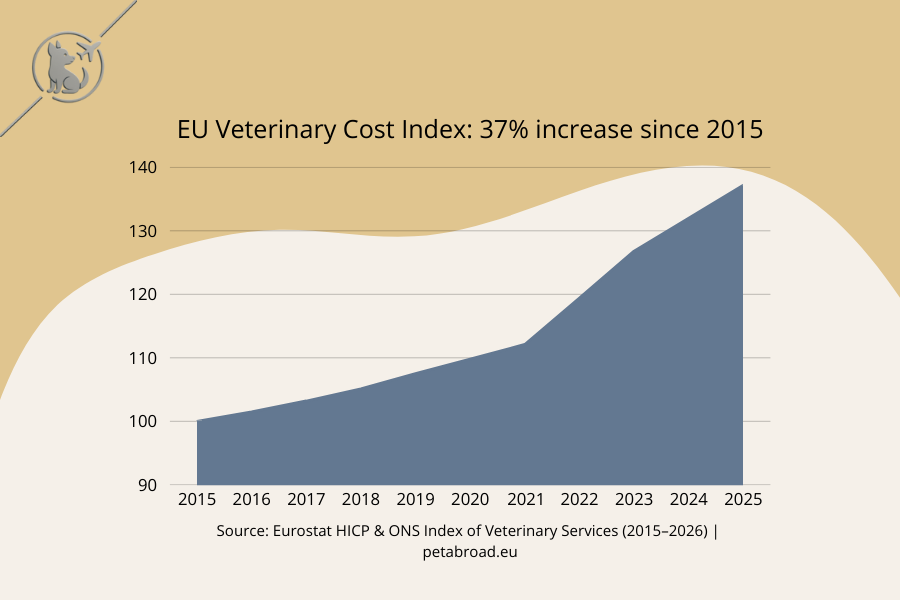
Pet healthcare costs are no longer following the normal economy. Since 2015, average EU vet prices have jumped by 37%, but the real shock came between 2022 and 2025 when costs in the UK and Nordic countries nearly doubled.
While general inflation has cooled to around 2%, veterinary fees are still charging ahead at 6% annually. This isn’t just a small price hike; it is a fundamental shift that has turned routine care into a major financial hurdle, especially for those traveling between the affordable East/South and the hyper-expensive North.
Related guides for your journey: If you are going by plane, check our
- Veterinary vs EU inflation ›
- Price increase sice 2015 ›
- The corporate takeover of clinics ›
- Vet costs in European regions ›
- Is insurance the answer ›
- Comparison of the prices ›
- Vet tourism ›
- FAQ ›
Veterinary inflation vs general inflation in the EU
The real problem is that vet bills aren’t playing by the same rules as the rest of the economy. While the price of milk or electricity has started to calm down across the EU, vet inflation is still sprinting.
Most countries are seeing general inflation around 2%, but vet fees are often jumping by 5% or 6% annually. In the UK, the gap is even crazier. Clinics are having troubles with big staff shortages and expensive new technology, and they are passing every cent of those costs directly to pet owners.
Vet cost increases since 2015: what the data shows
If you look back ten years, the price jump is staggering. Since 2015, average EU vet costs have climbed by roughly 37%, but that is nothing compared to the North. In Finland and Sweden, the spike has been brutal, with prices for common surgeries often doubling in that timeframe.
While countries like the Czech Republic still offer relatively sane prices, the Nordic markets have moved into a different league entirely. Most of this “price shock” happened in a violent burst between 2022 and 2025, leaving pet owners with a permanent new reality of high-cost care.
The death of the “neighborhood vet”
One of the biggest reasons for the price explosion, especially in the North, is the disappearance of independent clinics. In countries like Finland or the UK, the friendly local vet who ran their own practice for decades is becoming a ghost. They are being bought out by massive corporate groups backed by private equity. While these corporations bring high-tech equipment and 24/7 services, they also bring a “profit-first” mindset.
When a clinic is owned by a corporation, every minute of the vet’s time is tracked, and every test is monetized. These companies have the power to set the market price, and without small, independent competitors to keep them in check, the costs for pet owners simply skyrocket. We are losing the heart of veterinary medicine —care based on a personal bond and love for animals— and replacing it with a polished, high-tech, but very expensive corporate machine.
Which European countries have the highest vet costs
Crossing a border with your pet in 2026 can feel like entering a different financial reality. There is no such thing as a “standard” European price for vet care.
Instead, we have a map where a procedure that costs a few hundred euros in one country can easily spiral into the thousands just a short flight away. The gap between the expensive North and the more affordable East has never been wider.
Northern Europe: why vet care is most expensive in Nordic countries
Nordic countries are currently in a league of its own when it comes to high costs. In Finland and Norway, the combination of high wages and a shortage of specialists has pushed prices to eye-watering levels. Another problem is an insurance that can actually drive prices up. Because most pets are insured, clinics set premium rates assuming an insurance company will pay. The problem is that many policies have huge gaps, often excluding dental care or pre-existing conditions. This leaves owners paying “insured prices” out of their own pockets.
A great example of this is the cost of basic dental hygiene. In Finland, we heard a story from a local taxi driver who was still reeling from his last vet bill—he had just paid over 1000 EUR just to have his insured cat’s teeth cleaned with two extractions included. In Norway and Denmark, prices are similarly inflated due to high labor costs and the assumption that everyone is covered. For a traveler, a small health issue in the North can easily cost more than the rest of the trip combined.
Germany: rising vet costs under the new fee structure (GOT)
Germany used to be a safe bet for fair pricing, but the new GOT (the official fee schedule) has changed the game. Vets are now legally required to charge within certain multipliers, especially for emergency care. If your dog gets sick on a Sunday night, the law forces the vet to charge you at least double or triple the base rate, plus a mandatory emergency fee.
It has reached a point where a simple ear infection on a weekend can cost as much as a night in a high-end hotel. The transparency is nice, but the “cheap local vet” is officially a thing of the past in Germany.
The UK: sharp price increases and corporate-owned clinics
The UK is currently the center of a massive row over vet pricing. A major 2026 investigation into the industry confirmed what many owners suspected: big corporate chains are driving up costs.
These massive groups now own over 60% of UK practices, and they often charge about 17% more than the few independent vets left. With prices up 60% since 2016, the UK has become one of the most expensive and stressful places to own a pet in Europe.
— Read about flying your dog to/from the UK — ✈️
Western vs Central Europe: where vet care is still more affordable
The silver lining for pet owners is that places like Poland, the Czech Republic, and Spain still offer world-class care without the “Nordic” price tag. While they aren’t immune to inflation, the baseline is much lower.
It is becoming very common for owners in Germany or Austria to drive across the border into the Czech Republic for planned surgeries or dental work. You can often get the exact same MRI or orthopedic surgery for less than half the price. In 2026, traveling for vet care isn’t just a trend—it’s a financial necessity for many.
Is pet insurance always a response to rising vet costs?
Insurance feels like a necessity, but it can actually drive prices up. In markets like Sweden or the UK, where most pets are covered, clinics set “premium” prices because they know the company pays. This creates a bubble: vet fees rise, insurance premiums follow, and the owner gets stuck in the middle.
The real trap is the fine print. Many policies now have so many exclusions—like dental work or hereditary issues—that you’re often paying for a “safety net” that isn’t there. As that 1,000 EUR bill in Finland showed, being insured doesn’t stop you from paying a fortune out of pocket when the clinic claims a procedure is “routine” and not “medical.”

However insurance remains the only safety net, especially when flying with your pets because we know now how airlines legally view your pets during travel.
Comparison of vet prices for passport stamp in Europe
Since the Pet Abroad team travels often with pets, we have visited dozens of clinics across Europe over the last few years. We have seen first-hand how the price of a simple “Fit to Fly” check can change the moment you cross a border.
It is the exact same clinical exam and blue passport stamp everywhere, but the bill you get at the end is wildly different. Here are the actual prices we have paid for a single passport stamp:
- Czech Republic ~ €15
- Spain ~ €15
- Malta ~ €25
- France ~ €50
- UK ~ €100
- Finland ~ €110
Will Vet Tourism become the new standard for pet owners?
With price gaps this massive, we are already seeing the rise of “vet tourism.” It is no longer just about getting a cheaper passport stamp; people are now planning their travels around their pets’ medical needs. If a dental cleaning with extractions costs 1,000 EUR in Finland but only 200 EUR in Spain or the Czech Republic, the savings literally pay for the entire holiday.
For the Pet Abroad community, this is a strategic way to manage the rising cost of living. In 2026, choosing where to treat your pet is just as important as choosing which insurance to buy. While emergency care will always be a gamble of location, planned procedures are moving East and South. Veterinary care is becoming a global market, and for those of us who travel, that is the only way to keep high-quality care affordable.
FAQ about veterinary costs Europe
Why are vet costs rising in Europe?
Costs are skyrocketing primarily due to the “corporatization” of the industry, where large investment groups buy local clinics and prioritize profit margins. This trend, combined with a post-pandemic shortage of veterinarians and the high cost of modern medical technologies, has pushed prices up much faster than general inflation.
In which European countries will I pay the most for veterinary care?
Northern Europe and the UK are currently the most expensive regions for pet owners. Countries like Norway, Denmark, and the UK have seen some of the highest price increases, partly due to high insurance penetration and a lack of state price regulation, whereas Southern and Central Europe remain relatively more affordable.
Is pet insurance still worth it in 2026?
Yes, but the strategy has changed. While premiums are rising, insurance is the only way to avoid life-altering bills for major surgeries or chronic conditions. Many owners are now opting for higher deductibles to keep monthly costs down while maintaining protection against catastrophic financial hits.
What is “Vet Tourism” and is it safe?
Vet tourism is the practice of traveling to countries like the Czech Republic or Poland for major procedures to take advantage of lower operational costs. It is safe and increasingly popular, as these countries often offer the same high-tech “gold standard” care as the West but at a fraction of the price.
Sources & Data references
- Eurostat (HICP Data): Harmonised Index of Consumer Prices – tracking veterinary services and pet product inflation across the EU (2015–2026).
- Office for National Statistics (ONS): Consumer price inflation, UK: detailed veterinary and medical service cost analysis.
- CMA (Competition and Markets Authority): Veterinary services market investigation report regarding corporate ownership and pricing transparency.
- Federation of Veterinarians of Europe (FVE): European Veterinary Survey on clinic ownership trends and staff shortages in the Nordic and Western regions.
- PetAbroad Internal Data: Real-world price comparison of Pet Passport stamps and routine check-ups across 12+ European countries (2015–2026).