


Flying with a large dog internationally usually means one thing: the cargo hold. However K9 JETS has changed this by offering a “pay-by-seat” model on private heavy jets, allowing your pets to sit right by your side in the cabin.
What is K9 Jets & how does the public charter model work?
K9 JETS is not a traditional airline. They operate as a public charter broker, which means they do not own the aircraft themselves but arrange flights through licensed air carriers.
Unlike renting a full private jet which can cost upwards of $100,000, K9 JETS sells individual seats on scheduled routes. This makes luxury pet travel more accessible, though it definitely remains a premium service compared to commercial flying. See how it works, how much it costs and much more!
Quick facts for travelers
- Model: Shared private jet charter (pay-by-seat).
- Cost: Average $8,000 – $11,000 per seat (human + pet included).
- Pet Policy: Pets stay in the cabin; no crates required for dogs, soft-sided bags for cats.
- Weight Limits: 1 seat = 1 large dog (over 51 lbs) OR 2 small pets (under 50 lbs each).
- Documentation: Owners are responsible for all international health certificates and entry permits.
- Terminals: Flights depart from private FBO terminals, avoiding main airport crowds.
How K9 JETS works: Step-by-Step experience
One seat purchase includes space for one human passenger and one large dog weighing over 51 lbs (23 kg). If you are traveling with smaller pets weighing under 50 lbs (22.5 kg) each, your seat allows you to bring two animals at no extra cost. For owners with multiple large dogs, purchasing an additional seat is necessary to make sure there is enough floor space for everyone to travel comfortably.
On the day of travel, you arrive at a Private Terminal (FBO) about an hour before departure. There are no long security lines or noisy crowds. You simply check in, meet other pet owners, and walk directly onto the plane.
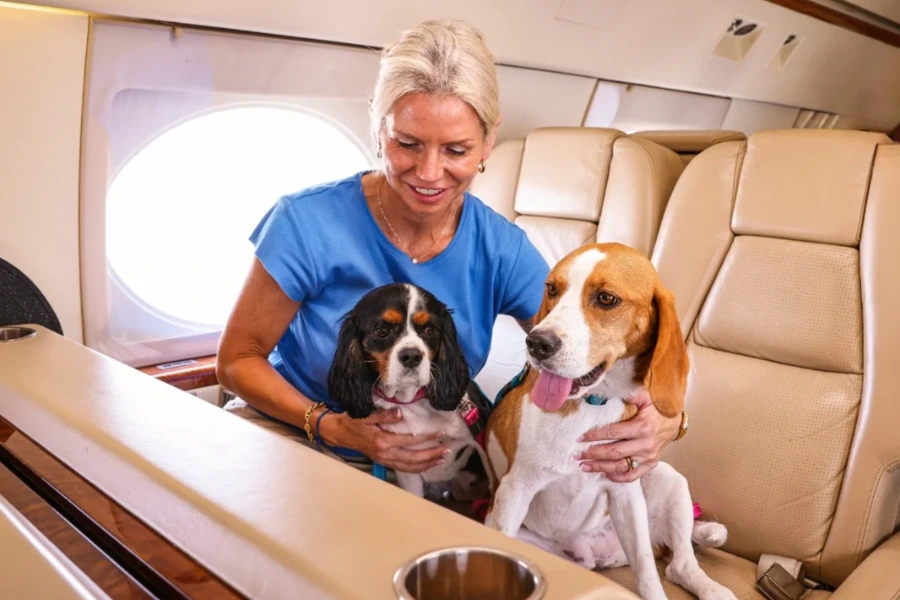
Once on board, the service is tailored to dog owners. The cabin is spacious, and the atmosphere is calm because every passenger is in the same boat—traveling with their furry friend.
K9 JETS Pet policy explained
The most important rule is that dogs are never caged. They can lay on the floor at your feet or even sit on the seat next to you if you use a protective cover. For dogs over 51 lbs (23 kg), one seat purchase covers one dog. If your dog is smaller—under 50 lbs (22.5 kg)—you can actually bring two pets per seat.
Cats are also welcome but must remain in a soft-sided carrier for safety during the flight.
There are no breed restrictions, which is a massive relief for owners of “bully breeds” or snub-nosed dogs that are often banned by commercial airlines.
Accepted animals on K9 JETS flights
- 🐶 Dogs: All breeds are welcome with no restrictions on “power breeds” or brachycephalic (snub-nosed) dogs.
- 🐱 Cats: Felines are welcome on all routes but must remain in a secure, soft-sided carrier for the duration of the flight.
- 🦮 Service animals: Fully trained service dogs are accepted and fly under the same cabin-sharing rules.
- 🐾 Other pets: While the focus is on dogs and cats, other small domestic pets may be considered on a case-by-case basis. You should contact K9 JETS directly before booking for birds or small mammals.
International pet travel documentation: The missing piece
While K9 JETS handles the flight perfectly, they do not manage your pet’s legal paperwork. Even on a private jet, it is you who must comply with the entry requirements of your destination country.
For flights to the UK or EU, you still need a Pet Health Certificate or an EU Pet Passport. You must also ensure your dog has a microchip, a valid rabies vaccination, and the mandatory tapeworm treatment (depending on your destination, find more info here) administered by a vet 24–120 hours before landing.
Always double-check these requirements weeks in advance. A seat on a jet won’t help you if the border authorities deny entry due to a missing signature on a health form.
Popular K9 Jets routes & expansion
The K9 JETS network focuses on the “heavy lifters”—the long routes where cargo travel is most exhausting for animals.
- The Transatlantic Bridge: The most frequent route is between Teterboro (New Jersey) and Farnborough (London area). These flights run multiple times a month and are the backbone of the service.
- European Hubs: They have established regular connections between the US and major European cities like Paris (Le Bourget), Milan (Malpensa), and Lisbon. These are vital for expats and military families moving to the continent.
- The Middle East & Asia: The route to Dubai (Al Maktoum) has become increasingly popular for those moving between Europe and the UAE.
- Recent Expansions: They have recently added Toronto to their North American network and frequently run “seasonal” routes to places like Geneva or various stops in Florida, depending on demand.
K9 JETS cost & pricing: Is it worth it?
A seat on a transatlantice flight typically costs between $8,000 and $10,000. It is expensive, but you have to weigh the cost against the alternatives. Shipping a large dog via cargo can cost between $3,000 and $6,000 and involves significant stress and potential health risks.
That said, it’s certainly a luxury—and we’ll explore whether it’s the right fit for you in this section.
K9 JETS vs. Commercial airlines vs. Bark Air
Commercial airlines are the cheapest option, but for large dogs, cargo is the only choice. This often leads to anxiety for both the owner and the pet.
Bark Air is a newer competitor that is even more “dog-centric,” offering things like “dog champagne” and pheromone-scented towels. However, K9 JETS currently has a wider variety of international routes and a more established schedule for long-haul relocations.
User reviews & Real-world experience
Most feedback from the community highlights the community aspect. Dogs tend to settle down quickly once the engines start, and seeing other calm dogs helps anxious travelers.
On the other hand the most common complaint is not the service itself, but how quickly seats sell out—often months in advance.

Who K9 JETS is for (and who it isn’t)
This service is a game-changer for specific types of travelers, but it isn’t the right fit for everyone.
It is for you if: You have a large dog breed that is banned from commercial cabins, you are relocating permanently across the ocean, or your pet has severe anxiety and cannot handle being separated from you. It is also the go-to choice for owners of snub-nosed (brachycephalic) breeds who want to avoid the respiratory risks associated with cargo travel.
It is not for you if: You are on a tight budget, or if you have a very small dog or cat that already fits comfortably in a carrier under a standard airplane seat. If your pet can fly for a +- €80 cabin fee on a commercial airline, paying this high-end price for a jet seat is likely unnecessary unless you specifically want the private experience.
Markéta’s final thoughts
“K9 JETS has filled a massive gap in the market. It is the best balance between the extreme cost of a full private charter and the risks of commercial cargo. If you are relocating across the ocean or moving abroad permanently, it is the gold standard for pet safety. Just remember: book early and stay on top of your vet paperwork.”
FAQ about K9 JETS pets travel
Here are the most common questions and our answers to get the most important information about K9 JETS.
How much does it cost to fly on K9 JETS?
Standard pricing for a seat on a transatlantic route usually falls between $8,000 and $11,000. This price includes the human passenger and one large dog (or two smaller pets). Prices vary based on the specific route and current demand, but the “pay-per-seat” model is the most cost-effective way to access a private cabin for your pet.
Are K9 JETS safe?
Yes, K9 JETS operates as a public charter broker and only partners with licensed aircraft operators that meet strict safety regulations, such as FAA Part 135. They utilize top-tier heavy jets like the Gulfstream IV or Bombardier Global Express, which are maintained to the highest industry standards for long-haul travel.
Is K9 JETS worth it?
The value depends on your dog’s needs and your budget. For owners of large breeds or snub-nosed dogs that are physically unable to fly in a commercial cabin, K9 JETS provides the only safe alternative to the cargo hold. When you factor in the peace of mind and the physical safety of your pet during a 10-hour flight, most users find the cost justifiable.
Do dogs need to be in a crate on K9 JETS?
No, dogs are not required to be in a crate. They can lie on the floor at your feet or sit on the seat next to you if you use a seat cover. This is one of the primary reasons owners choose this service over commercial cargo options. Cats, however, must remain in a soft-sided carrier for safety.
Can I fly with a large dog on K9 JETS?
Yes, K9 JETS is specifically designed for large dogs that cannot fit under the seat on a commercial flight. There are no weight limits for individual dogs, though you may need to purchase an additional seat if you are traveling with multiple large pets.
Are K9 JETS flights shared?
Yes, you are buying a seat on a shared flight with other pet owners. This is how the cost is kept lower than a private charter.