

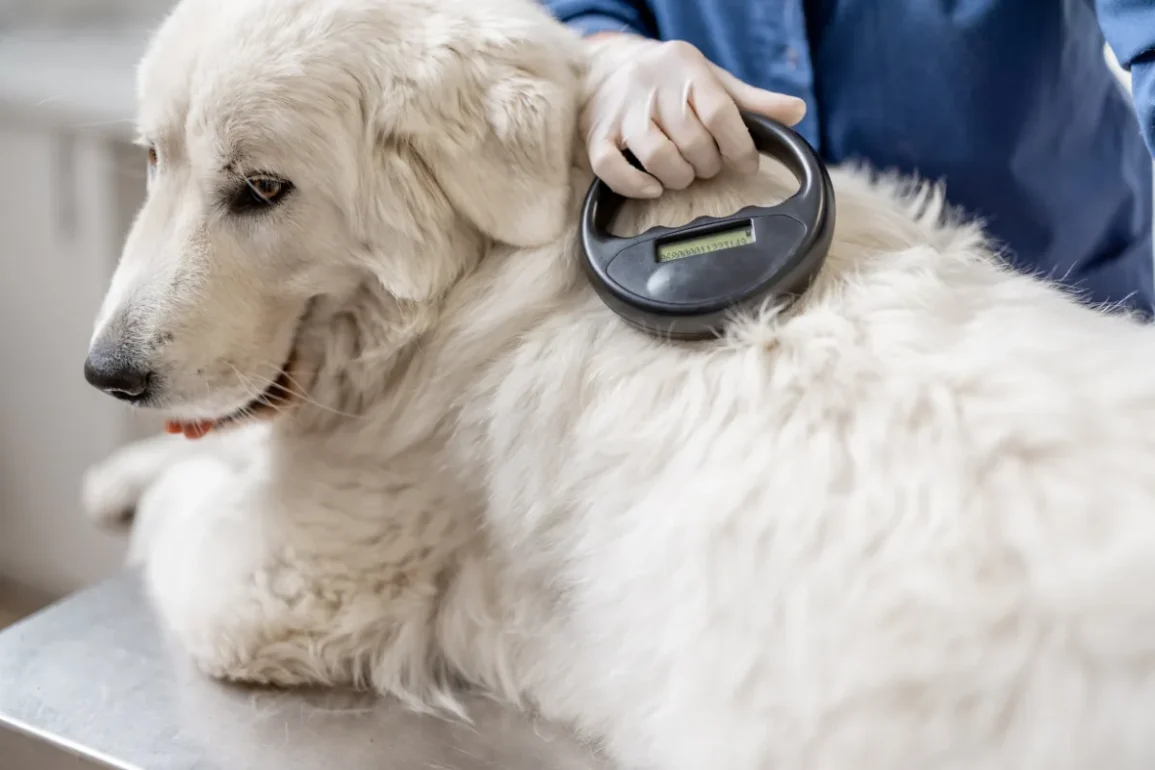
A tiny microchip plays a big role when you travel with your dog, cat or ferret. If you’re not entirely sure how it all fits together with passports, vaccines and country rules, this article brings everything into one clear place – and gives you all the answers you are looking for.
Pet microchip for travel: What it is and how does it work
A microchip is a tiny capsule that your vet slips under the skin between the shoulder blades of your dog, cat or ferret — a quick moment and it’s done. Inside isn’t anything fancy or high-tech; it simply holds one number. No GPS, no tracking, nothing that pings your location. Just a permanent ID your pet carries for life.
When a vet, airport officer, or anyone with a scanner reads the chip, that number comes up straight away and connects to your details in the database. That’s how authorities confirm that the dog standing in front of them is the same one listed in the passport and vaccinated in the records.
It’s a small thing, but it’s the piece that holds all other travel documents together — without the microchip, nothing else is officially valid, and that is why it’s one of the most important travel requirements for traveling.
Quick facts about pet microchips
- A microchip is a tiny capsule your vet places under the skin in a quick visit – no surgery, no long recovery.
- It holds one unique number for your pet for life; it doesn’t run out, need charging, or expire.
- It isn’t a GPS or tracker – the number can only be read with a scanner at a vet, shelter, or border check.
- For travel, microchipping is required mainly for dogs, cats and ferrets.

Everything about the pet microchip for travel
You can jump to any section if needed ↓
- Why your pet needs a microchip for travel ›
- ISO-compatible microchip requirements ›
- When to microchip your dog or cat ›
- Countries that require a microchip for travel ›
- How to prepare your dog for travel with a microchip ›
- Common issues and how to avoid them ›
- FAQ: pet microchip and travel ›
Why pet microchip for travel is a must
When travelling, the microchip acts as your pet’s official ID. It’s what links them to their rabies vaccination, passport, and every other document you’ll need on the road. If the chip can’t be read — or was implanted after the rabies shot — the paperwork simply isn’t valid.
Most countries check the microchip before anything else, so it’s the one thing you really want to have sorted. And beyond the rules, it’s also what brings your pet back to you if they ever get lost in an unfamiliar place. A quick scan, your details pop up, and they’re safely reunited with you.
A tiny implant, but absolutely essential for travel.
ISO-compatible microchip requirements
Most countries follow one simple rule: your pet’s microchip has to meet ISO-compatible microchip requirements. In practice, this usually means the standard 15-digit ISO chip that vets use these days as a matter of routine.
These chips can be scanned anywhere — airports, border checks, local vets — without anyone needing special equipment. If your pet happens to have an older or unusual microchip, most people just get a new ISO one as it saves a lot of explaining and problems during travel.
If you are not sure which chip your pet has, ask your vet to scan it.
What “ISO” actually means
ISO is just a global technical standard that makes sure every microchip speaks the same “language”. When a chip follows the ISO rules, any standard scanner can read it — whether you’re in Berlin, Barcelona, or Boston.
Nothing complicated, just a way to guarantee that the number on your pet’s chip shows up correctly everywhere you travel.
When to microchip your dog, cat or ferret
Most pets get their microchip when they’re still quite young, often during their first vet visits. There isn’t a strict “best age”, but the important part is this: your pet must be microchipped before their rabies vaccination. If the order is reversed, the vaccine doesn’t count, and you’ll need to start again.
If you adopted an adult pet, don’t worry — they really can be chipped at any age. It’s quick, it doesn’t require any special recovery time, and your vet can check the chip during the same appointment.
For anyone planning a trip, it’s worth getting this sorted early. Once the microchip is in place, you don’t need to think about it again — it stays with your pet for life, and it keeps all future travel paperwork valid.
Countries that require a microchip for dogs and cats
A lot of countries have their own rules for pet travel, but they all start in the same place — with a working microchip. What changes is the small print, and that depends on where you’re flying. To make it easier to navigate, here’s a simple look at how it works all over the world.
European Union (EU & EEA countries)
In the EU, things related to pet travel are pretty simple and clear. Pets need a 15-digit ISO microchip, and it has to be in place before the rabies vaccine. If the chip scans cleanly and the number matches the passport, everything goes very quick.
From our own experience at the Pet Abroad team we rarely see that the microchip is checked at the airport or arrival, however it is important to have these papers in order.
United Kingdom (post-Brexit)
The UK checks the microchip straight away on arrival. Same idea as in the EU: an ISO chip, implanted before the rabies shot. If you’re travelling with a dog, they also require the tapeworm treatment, but the microchip is always the first thing they confirm. You can read more about traveling to and from the UK here.
United States & Canada
Both the US and Canada strongly recommend the standard 15-digit ISO microchip — and most vets use it by default — but the specific microchip rule is often tied to rabies certification. When arriving with a pet, authorities must be able to read the chip to confirm the vaccination belongs to the right animal. If they can’t, the entry process can take much longer.
🐾 — EVerything about pet travel USA — ✈️
Australia, New Zealand & Asia
Countries like Australia and New Zealand have some of the strictest biosecurity rules in the world, and the microchip is checked very carefully on arrival. Pets must have a readable ISO chip, and all health documents must match the chip number exactly. Many Asian countries follow a similar approach, especially Japan, Singapore and South Korea — readable microchip first, paperwork second.

Middle East, Latin America & others
Most destinations in Middle East, Latin America and rest of the world follow the same principle: a readable ISO microchip linked to the rabies vaccination. But always keep in mind that every country has its own set of other rules related to pet travel that are good to know before.
How to prepare your dog for travel with a microchip
Before any trip, it’s worth having your vet scan the microchip just to make sure it still reads the way it should. Chips don’t really “go bad”, but scanners sometimes pick up weak signals, and it’s better to find that out in the clinic than at an airport counter.
If you’ve moved house or changed your phone number since the chip was registered, update your details in a case your dog or cat ever gets separated from you during the journey. Once the chip reads cleanly and the information behind it is correct, there’s nothing more you need to do — the microchip simply sits there and does its job while you travel.
Common issues and how to avoid them
Most problems with microchips at the border come back to a few small mistakes. If you keep an eye on these, you’re good to go.
- Rabies done before microchip
- Chip that doesn’t scan properly
- Old or non-ISO microchip
- Outdated details in the database
- Wrong chip number in the documents (e.g. EU Pet passport)
FAQ: pet microchip for travel
What does a microchip do to a pet?
The microchip just sits under the skin and stores one identification number. It doesn’t change how your pet feels or behaves; it’s simply a permanent ID that vets, shelters, and border officers can read with a scanner.
What does it mean if a pet is microchipped?
It means your dog or cat has that unique number linked to your contact details in a database. When someone scans the chip, they can see who the animal belongs to and how to reach you – which is especially important if your pet gets lost while travelling.
Can you track a pet with a microchip?
No. A microchip isn’t a GPS tracker. It can’t show where your pet is in real time. It only works when someone scans it and reads the number. If you want live tracking, you still need a separate GPS collar or tag.
Are microchips safe for pets?
For the vast majority of pets, yes. Vets have been using them for many years and complications are rare. The chip is tiny, the procedure is quick, and most animals react no more than they would to a normal injection.
How long do pet microchips last?
Microchips are designed to last for life. They don’t run on batteries and they don’t “run out”. Once it’s in place and working, you usually never need to replace it – just keep your contact details up to date.
What are the disadvantages of microchipping?
The main drawback is that it doesn’t help if the information behind the chip is wrong or never registered. In very rare cases, a chip can move slightly under the skin or be tricky to read, which is why it’s smart to have your vet scan it now and then, especially before travel.
Do vets recommend microchipping?
In most countries, yes – and in many places it’s even required by law. Microchipping makes it much easier to return lost pets to their owners and is a basic requirement for international travel.
Do pet microchips expire?
No, they don’t expire. The chip keeps working, but the details in the database can become “outdated” if you move house or change phone number, so that’s what needs updating, not the chip itself.