

Moving to Europe with pet takes some planning and that is the reason we’ve decided to put together this guide. You can find here information about necessary paperwork and vaccines, flights and border checks and much more.
Overview: What you need to know
To move your pet to Europe in 2026, you’ll need a microchip, valid rabies vaccine, and either an EU Pet Passport or EU Health Certificate (EHC) depending on where you’re coming from. Check your airline’s pet policy, book a vet-approved crate, and arrive through an official EU entry point (BCP).
Step-by-step guide to bring dog to EU
Below you’ll find everything you need to plan your move with a pet — from paperwork and travel prep to what happens once you land in Europe. Click any section to jump straight to what you need.
- Legal requirements for entering the EU ›
- Before you go: Preparing your pet ›
- Costs and fees to expect ›
- How to fly with your pet ›
- Living in Europe with your pet ›
- Common mistakes to avoid ›
- Moving to Europe with a pet: Checklist ›
- Useful links & resources ›
You can also check our guides here:
Legal requirements for entering the EU
Bringing your pet into Europe isn’t complicated once you know the rules — but there are a few key documents and timeframes you should know.
Traveling within the EU (EU Pet Passport)
If you’re moving from one EU country to another, things are very easy for you as your pet needs only these three essential things:
- a valid EU Pet Passport,
- a microchip that follows the ISO 11784/11785 standard,
- and a current rabies vaccination recorded by your vet.
The EU Pet Passport really makes life easier. Once your dog’s rabies jab is up to date, you can cross borders inside Europe without thinking twice. Just don’t forget to glance through the pages now and then — one missing stamp or an old date can suddenly turn a smooth trip into a long chat with border control.
If you’ve recently adopted your dog or cat in one EU country and are moving to another, always check the chip number in the passport matches the one in your pet’s microchip. It sounds obvious, but I’ve seen travellers turned back over a small mismatch.
Entry from Non-EU countries (Health Certificate)
On the other hand moving to the EU from outside — whether it’s from the UK, the US, or elsewhere — requires a different document: the EU Health Certificate (EHC) or an equivalent Third-Country Veterinary Certificate.
This is a one-time document confirming that your pet:
- is microchipped,
- has a valid rabies vaccination, and
- was checked by a veterinarian before travel.
The AHC must be issued no earlier than 10 days before your arrival in the EU. After landing it is valid for four months for travel inside the EU or until the rabies vaccine expires — depending on which comes first.
Only authorised “Official Veterinarians” can issue the AHC, so book the appointment in advance; not all vets are licensed for this. Also, bring your pet’s vaccination proof with you — it’ll make the process faster.
Do pets need to quarantine when entering Europe?
In most cases, no. If your pet’s microchip, rabies vaccination and paperwork are all correct, there’s no quarantine required when entering the EU.
Quarantine is only applied in rare situations — for example, if a rabies vaccine isn’t valid, or if the paperwork is incomplete.
Tapeworm treatment requirements (Echinococcus)
If you’re coming in from the UK, Ireland, Finland, Malta or Norway, there’s one little formality that catches a lot of people out — the tapeworm treatment. Your dog needs to get it from a vet a day or two before the trip (no earlier than five days). It’s quick, inexpensive, but essential — without it, your pet won’t be allowed to enter.
The treatment and timing have to be recorded in your pet’s passport or on the health certificate. Skipping it could lead to entry refusal — something no one wants to deal with after a long flight.
🐾 Related read: Tapeworm treatment rules for dog travel
Special cases & Breed restrictions
Some European countries enforce specific breed restrictions for safety reasons. So-called “aggressive” breeds such as Pit Bull Terriers, Staffordshire Terriers, Rottweilers, Dogo Argentinos, or Tosa Inus — may be banned or allowed only under certain conditions.
For example countries like Germany and Denmark have strict bans on several breeds.
France classifies dogs into categories, where some can travel only with extra documents or a muzzle.
If your dog is one of the listed breeds, check the exact entry rules of your destination before booking flights or ferries.
Also note that puppies under 12 weeks old usually can’t enter the EU because their rabies vaccination isn’t yet valid — some exceptions apply, but only with prior approval from veterinary authorities.
Before you go: Preparing for the move
Getting ready to move to Europe with your pet takes a bit of planning — more than just buying a ticket. It’s about giving yourself and your furry friend enough time to prepare, from vet visits to travel crates.
Here’s what to do in the weeks before the big move 👇
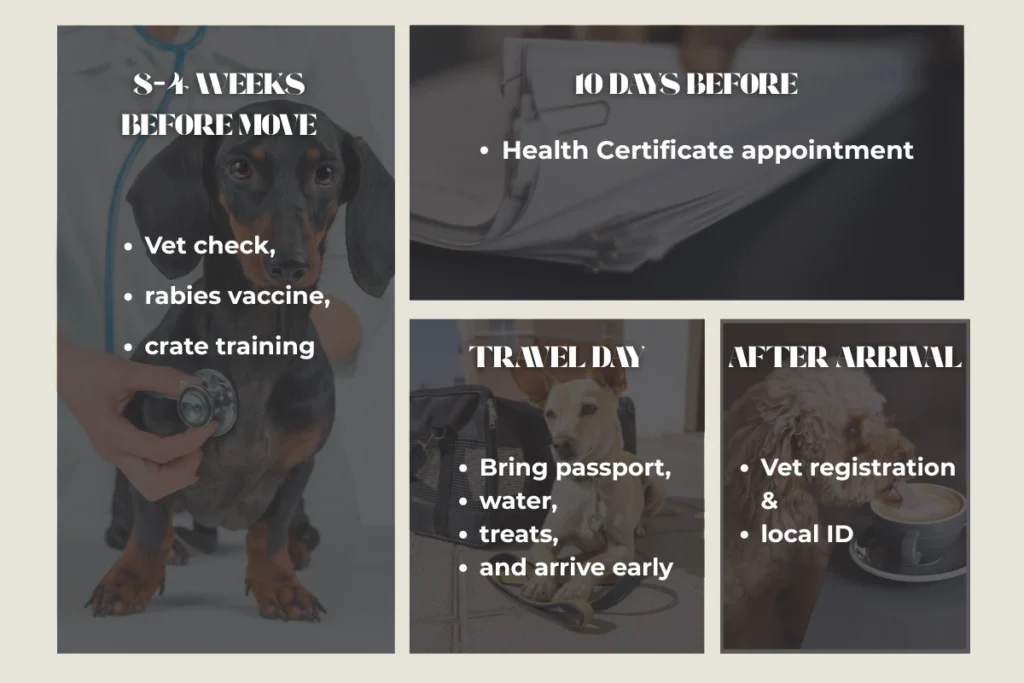
Vet check & vaccination schedule
Schedule a full vet check a few weeks before your move — that gives enough time to update vaccinations or sort out any health concerns. Make sure your pet’s rabies vaccine will still be valid by your travel date (and ideally for several months after). Some EU countries can refuse entry if it’s close to expiring.
If you’re coming from outside the EU, you’ll need the EU Health Certificate (AHC). Inside the EU, it’s usually enough to have your Pet Passport updated and treatments recorded if required.
💡 Pet Abroad tip: Ask your vet to double-check that your pet’s microchip number matches the passport — it’s a tiny detail that can save you big stress at customs.
Read all about dog vaccination for traveling here.
Choosing the right crate & training your pet
Whether your pet travels in the cabin or in the hold, the right carrier makes all the difference — for both of you.
For in-cabin travel, choose a soft side carrier that fits under the seat but still is big enough for your pet to turn and lie down comfortably. For pets flying in the hold, you’ll need a hard-sided crate that meets IATA standards and is big enough for your pet to stand, turn, and lie down.
Whatever type you use, give your pet time to get used to it. Leave it open at home for a week or two with a blanket, toy, or even an old jumper inside — familiar scents help your pet stay calm during the trip.
Planning your travel route & entry airport
Not every entry point in Europe handles pets the same way. Some airports and ferry ports make the process far easier, with on-site vet checks, pet relief zones, and staff who actually know what to do.
If you’re flying, try to arrive through an official Border Control Post (BCP) that accepts animals — not every airport does. These are most often smaller, regional airports which sometimes won’t allow pet entry at all, so do not forget to check this one out before you book.
Costs of moving with a pet to Europe
Of course the final price will depend on many factors, but expect to spend between €200 and €800 in total, depending on your pet’s size and where you’re coming from.
Here’s a rough idea of what to budget for:
- Vet paperwork and vaccines: €80–€300 (including the Animal Health Certificate or rabies update)
- Airline fees: €40–€100 for pets in cabin, €150–€600 for pets in the hold
- Travel crate or carrier: €50–€250 depending on size and quality
- Extra costs: local registration fees or optional pet insurance once you arrive
How to travel with your pet
Once all the papers are ready, the next question is how you’ll actually get there. Flying with a pet sounds stressful, but with a bit of planning, it’s manageable — honestly, it just takes some patience and common sense.
Cabin, Checked baggage, or Cargo?
If your dog or cat is small enough, you can take them to cabin with you – most airlines allow pets up to around 8 kg including the carrier, though the rules can vary.
Bigger pets usually must travel in the hold. Its is not ideal but many people, including us in the Pet Abroad team have done it and it’s fine if you prepare.
If your pet travels in hold, it’s always good to notify the flight attendants that you have an animal in the hold when boarding.
What to pack for the trip
We always travel with a small “pet bag”, and it’s saved us more than once. Here’s what’s inside ours:
- pet passport or health certificate
- water and a small collapsible bowl
- treats or a chew for take-off and landing
- spare leash and poop bags
- wipes and tissues (you’ll need them)
- blankets or toys that smells like home
Transit rules & stopovers
Stopovers can be messy when you’re travelling with a pet. Inside the EU it’s usually fine, but some airports outside it need extra paperwork — and you don’t want to find that out mid-trip.
If possible, go for a direct flight. It’s calmer for both of you. And if you have to change planes, keep it short and make sure both airlines follow the same pet rules. One small mismatch can turn into a big problem fast.

Living in Europe with your pet
European countries are very pet-friendly and you find local vets, dog parks, and plenty cafés or beaches here. What can feel new at first are the small everyday rules – things like where dogs can run free, or the need to register your pet with a local vet soon after you move.
Once that’s done, you’ll realise how well pets fit into daily life here. People walk their dogs everywhere, from city streets to cafés, and most places are used to seeing them around. It’s a good mix of freedom and responsibility — and your pet will probably love it as much as you do.
Local registration & vet visit
After arrival we always recommend to find a local vet so you know where to go for check ups. Also in most countries you should register your pet.
It’s also a good time to get information about local rules, vaccines, or anything that might be different from your home country. Because every country has its own routine — for example, some recommend extra tick or worm treatments depending on the area. Having a local vet you trust makes life much easier.
Pet insurance & healthcare
Vets in Europe are usually great, but the prices can surprise you. A quick check-up might be cheap in one country and double the price just across the border. In Germany, France or the Netherlands, everyday visits are fair, but surgery or an emergency call can hit your wallet hard.
If you’re moving for good, look into pet insurance early on. It’s especially worth it in places like Norway, Sweden, Denmark or Finland, where vet care costs more. It won’t cover everything, but having insurance helps when life throws you one of those unexpected “my dog just ate something weird” moments.
Pet laws, leash rules & pet-friendly living
Each European country has its own set of rules for pets, and it’s worth learning them early. In most cities, dogs must be on a leash at least in public areas. You are also – as a owner – expected to clean up after your pet.
Many cafés, pubs, and shops are dog-friendly, especially in places like Germany, France, or Portugal. You’ll often see water bowls outside and staff happy to bring a treat. Trains and trams usually allow pets too — smaller ones in carriers, bigger dogs on a lead with a muzzle.
🐾 — Read: Eurostar trains pet policy — 🚆
Common mistakes & what to avoid
Most travel problems with pets come down to small things people forget. A missing stamp. A vaccine that’s a week out of date. A chip that no one checked before the trip etc.
Before you fly, check every page of your pet’s passport. Make sure the chip number matches, the rabies shot is valid, and your vet has signed and dated everything properly.
Another easy mistake? Booking a flight into an airport that doesn’t accept animals from outside the EU. That’s why it’s important to check a Border Control Post (BCP) at your arrival airport.
And finally — don’t leave crate training until the last day. A pet that’s calm in their carrier will handle the whole trip better, and so will you.
Checklist for moving to Europe with pet
- All travel documents (passport, microchip, rabies vaccine) are valid and signed.
- Tapeworm or other treatments are completed and recorded.
- The right paperwork — EU Pet Passport or EU Health Certificate (EHC) — is ready.
- Airline confirms your pet’s spot on your route.
- Crate or carrier fits airline rules.
- Arrival airport accepts animals from outside the EU.
- Water, leash, snacks, and blanket packed.
A quick look through this list can save you a lot of stress at the airport — and make sure your furry friend arrives safe, calm, and happy.
Resources & useful links
- Official EU pet travel rules — the European Commission’s latest guidance on entering and travelling within the EU.
- Pet Abroad: Health Certificate Guide — full breakdown of how to get an EU Health Certificate step-by-step.
- Airline pet policies — check out our articles to major carriers like Lufthansa, Air France, Vueling & more.
FAQs about relocating to Europe with your pet
Can I move to Europe with my dog or cat from the US or UK?
Yes — thousands of people move to Europe with their pets every year. You’ll just need to follow the EU entry rules: microchip your pet, have a valid rabies vaccination, and travel with the correct paperwork — either an EU Pet Passport (if you already live in the EU) or an EU Health Certificate (if you’re coming from the UK, US or another non-EU country).
What documents do I need to bring my pet to Europe?
You’ll need: a microchip that meets ISO standards, a valid rabies vaccination, and either an EU Pet Passport or an EU Health Certificate. Some countries like Ireland, Malta or Finland also require a tapeworm treatment before travel. Always bring the original documents — not just photos.
Does my pet need to go into quarantine when entering Europe?
No, as long as your pet meets all health and vaccination requirements, there’s no quarantine for entry into EU countries from approved origins like the UK, US or Canada. Quarantine is only required in rare cases where paperwork or vaccination timing doesn’t meet EU rules.
How far in advance should I start preparing my pet for the move?
Start preparing at least four to eight weeks before you travel. This gives you time to schedule vet visits, update vaccinations, book your EU Health Certificate, and help your pet get used to their travel crate or carrier.
How much does it cost to move a pet to Europe?
Costs vary depending on your pet’s size, airline and destination. Expect roughly €80–€300 for vet paperwork or the EU Health Certificate, €40–€100 for pets in cabin, and €150–€600 for pets in the hold. Don’t forget the cost of an airline-approved carrier and possible pet insurance once you arrive.
What are the most pet-friendly European countries for newcomers?
Portugal, France, Germany and Finland are among the most pet-friendly destinations in Europe. They offer excellent veterinary care, easy registration systems and plenty of dog-friendly cafés, parks and beaches.
Do I need a new EU Health Certificate every time I travel?
Yes. The EU Health Certificate (EHC) is a single-use document. It’s valid for 10 days to enter the EU, and then for up to four months for travel between EU countries. After that, you’ll need a new one for your next trip.